Skip to content

History of the Dog Tags

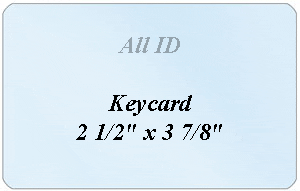
Keycard dimensions: 2.5" x 3.875".

The In the American Civil War of 1861, the way some soldiers kept their identification was to pin paper notes of their name and home address to the backs of their coats. Other soldiers stenciled their identification on their knapsacks or scratched it in the soft lead backing of the Army belt buckle. is produced by Articles. Articles specializes in developing premium products. All ID Focuses on sourcing only the most reliable products. This product was sourced by All ID because it is one of the top-rated products from Articles.


In the American Civil War of 1861, the way some soldiers kept their identification was to pin paper notes of their name and home address to the backs of their coats. Other soldiers stenciled their identification on their knapsacks or scratched it in the soft lead backing of the Army belt buckle.

Manufacturers of ID badges recognized there were a market there and began advertising in periodicals. The created pins were usually in the shape of the branch of service and engraved with soldier’s name and unit. Machine-stamped tags were also made of brass or lead with a hole and usually had (on one side) an eagle or shield and such phrases as War for the Union or Liberty, Union, and Equality. The other side had the soldier’s name and unit and sometimes a list of battles in which he had participated.

During the Spanish-American War in 1898, soldiers purchased crude stamped identification tags, sometimes with misleading information.

Franco-Prussian War
The Prussian Army issued identification tags for its troops at the beginning of the Franco-Prussian War in 1870. They were nicknamed mark which means “marks on dogs or dog marks”. Very similar identification tags instituted for dogs in the Prussian capital city of Berlin at about the same time.

First World War
The British, Canada, Australia and New Zealand forces issued ID tags from the beginning of the First World War. The tags were made of fiber, one in red and one in green and suspended around the neck by butcher’s twine. The same pattern was worn into the Second World War and the Korean War by the allied forces.

The U.S. Army first authorized identification tags in War Department on December 20, 1906, which essentially prescribes the Kennedy identification tag:

The identification tag made of aluminum, in the size of a silver half dollar, stamped with the name, rank, company, regiment, or corps of the soldiers, were worn by each officer and enlisted man of the Army.  The tag was suspended from the neck, underneath the clothing, by a cord or thong passed through a small hole in the tab. It was prescribed as a part of the uniform. The ID tags were issued by the Quartermaster’s Department to all enlisted men.

The Army changed their regulations in 1916, so that all soldiers were issued two tags: one to stay with the body and the other to go to the person in charge of the burial for record-keeping purposes. In 1918, the Army adopted and allotted the serial number system, and name and serial numbers were ordered stamped on the identification tags of all enlisted troops. In 1969 the Army began transitioning Servicemen were issued both a SSN and SN to the Social Security number for personnel identification. Germany had instead a single tag with identical information stamped on both sides of it, which could easily be broken off for the purpose of record-keeping.

World War II
There is a recurring myth about the notch situated in one end of the dog tags issued to United States Army personnel during World War II. It was rumored that the notch’s purpose was so that if a soldier found one of his comrades on the battlefield, he could take one tag to the commanding officer and stick the other between the teeth of the soldier to ensure that the dog tag would remain with the body and be identified. According to the notch is there simply to hold the tag in place on the embossing machine.

As a side note, it appears instructions that would confirm this myth were issued at least unofficially during the Vietnam War to Army troops headed overseas.

Following World War II, the US Navy Department adopted the dog tags used by the US Army and Air Force, so a single shape and size became the American standard.

Vietnam
In the Vietnam War, American soldiers were allowed to place rubber silencers on their dog tags so the enemy would not hear the metallic clanking. Others chose to tape the two tags together with black tape. Still others chose to wear one tag around the neck and the other tag on the lace of one boot. All three variations were commonly seen among U.S. troops.

Prior to the use of Social Security Numbers on dog tags beginning in the 1960s, the military printed the individual’s military service (or serial) number. Dog tags are traditionally part of the makeshift battlefield memorials soldiers create to their fallen comrades. The casualty’s rifle with bayonet affixed is stood vertically atop the empty boots, with the helmet over the stock of the rifle. The dog tags hang from the rifle’s handle or trigger guard. Service members also often give them to loved ones before deployments or when dating, similar to the student practice of giving a sweetheart one’s letter men jacket or ring to wear.
Plastic ID Card Printers

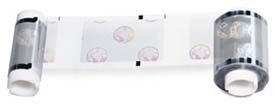
Clear plastic film with printed holograms.

The Plastic ID Card Printers was developed by Articles. Articles is a world leader in premium products. All ID Focuses on sourcing only the most reliable products. This product was sourced by All ID because it is one of the top rated products from Articles.


ID Card Printers > Conference Badge Printer > Plastic ID Card Printers

Plastic ID Card Printers

When attending a conference, guests are often given name tags. These may be printed on pieces of paper and placed in protective sleeves. Constructing them, however, can be very time consuming if there are many members attending an event. Plastic ID cards offer a more durable alternative to other types of name badges, and can be created with ease by specialized printers.

Options When Choosing a Plastic ID Card Printer

There are many features that should be considered when selecting a plastic ID card printer.

  • While some models are small and can be moved with ease, these units often do not produce identification badges as quickly as larger machines.
  • Conference organizers may consider monochrome printers, which can be less costly than systems that produce full-color badges.
  • At the time that they purchase an ID card printer, they may also choose to purchase software and cameras to take photos and design card backgrounds.
  • “…Some plastic ID card printers allow information to be added to a magnetic strip on plastic cards.” These can be used by membership organizations to track purchases and rewards, or to provide guests with controlled access to different venues.
  • When examining the cost of different plastic ID card printers, it is important to consider the cost of supplies, including overlaminate, ink and cleaning materials.

All ID offers a wide array of printers from top manufacturers including Fargo, CIM and Nisca. In addition to small and large printers and portable units, the company also carries supplies and offers maintenance services.


Thermal Label Printers

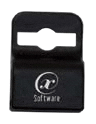
Brady 5710-3050 Gripper 30 Card Holder - Black ( 100 pack ) 5710-3050

The Thermal Label Printers is Manufactured by Articles. Articles specalizes in developing high tech products. All ID focuses on sourcing the newest and most advanced products. This product was sourced by All ID because it is one of the top rated products manufactured by Articles.


ID Card Printers > Label Printers > Thermal Label Printers

Thermal Label Printers

Thermal label printers provide organizations with a number of advantages compared to the alternatives. There are many applications for which these machines are suited, ranging from labeling large packages to dispensing receipts and identifying specimens. For any of these purposes, thermal printers produce labels that are easy to read and quick to produce.

Advantages to Using Thermal Label Printers

Thermal label printers are available from globally recognized manufacturers such as Zebra. “…Some of the models are capable of high-density printing, creating crisp graphics and text in small areas.” Thanks to the clarity these printers offer, the labels they produce are often used in medical labs. For example, if multiple employees will handle important vials, the labels can reduce the chance that an employee misreads the written information. This level of clarity can even be obtained at high print speeds. On some printer models, more than a foot in length can be run in one second. In addition to being clearer than dot matrix or inkjet printers, the labels produced by thermal printers can also be handled immediately after production (there is no lengthy ink dry time).

All ID carries a selection of thermal printers from Zebra, ranging from desktop to industrial models. Representatives from All ID can assist customers in selecting the model that is appropriate for the volume of work they intend to perform.

ALL ID’s New Website!

Zebra 800350-562 ZC350 Color Ribbon - YMCPKO - 200 Images (800350-562)

Welcome to ALL ID’s New Website!

Following several months of planning, we are excited to announce the launch of our new website!

The purpose of creating a new website was to better the experience for our customers.

You may not know it but we have been helping our clients for over 30 years. It’s fair to say that as a business we have been operating in stealth mode for quite some time, but now we are ready to stand up and shout about our recent awards, achievements, highlights and what we have to offer our clients. We are a big player in the market and it’s about time we started acting like it.

Don’t panic! We haven’t lost sight of our core values and we are still working towards being the best priced, fastest shipping, highest performing ID Printer and Label printer provider. Delivering a strong return on investment for our Clients.Our mission is still at the very heart of our business and our people live our values every day.

As well as adopting a totally new look, we’ve completely rethought the structure of the site to make things easier to find. Additionally, the site is now compatible with the latest tablets and smart phones to allow you to keep in touch while on the move.

Take a tour of our new website

We will be updating this Blog on a regular basis to keep you in touch with all the newest updates from All ID Systems and the industries we work in.

So, I invite you to take a tour around ALL IDs New Website, bookmark our website & connect with us on social media to stay up to date on our news. We will have a lot of news and insights to share in the coming weeks & months.